AI Voice Agents for Business: What They Actually Do (And When Not to Use Them)
Voice AI Is Not What It Was
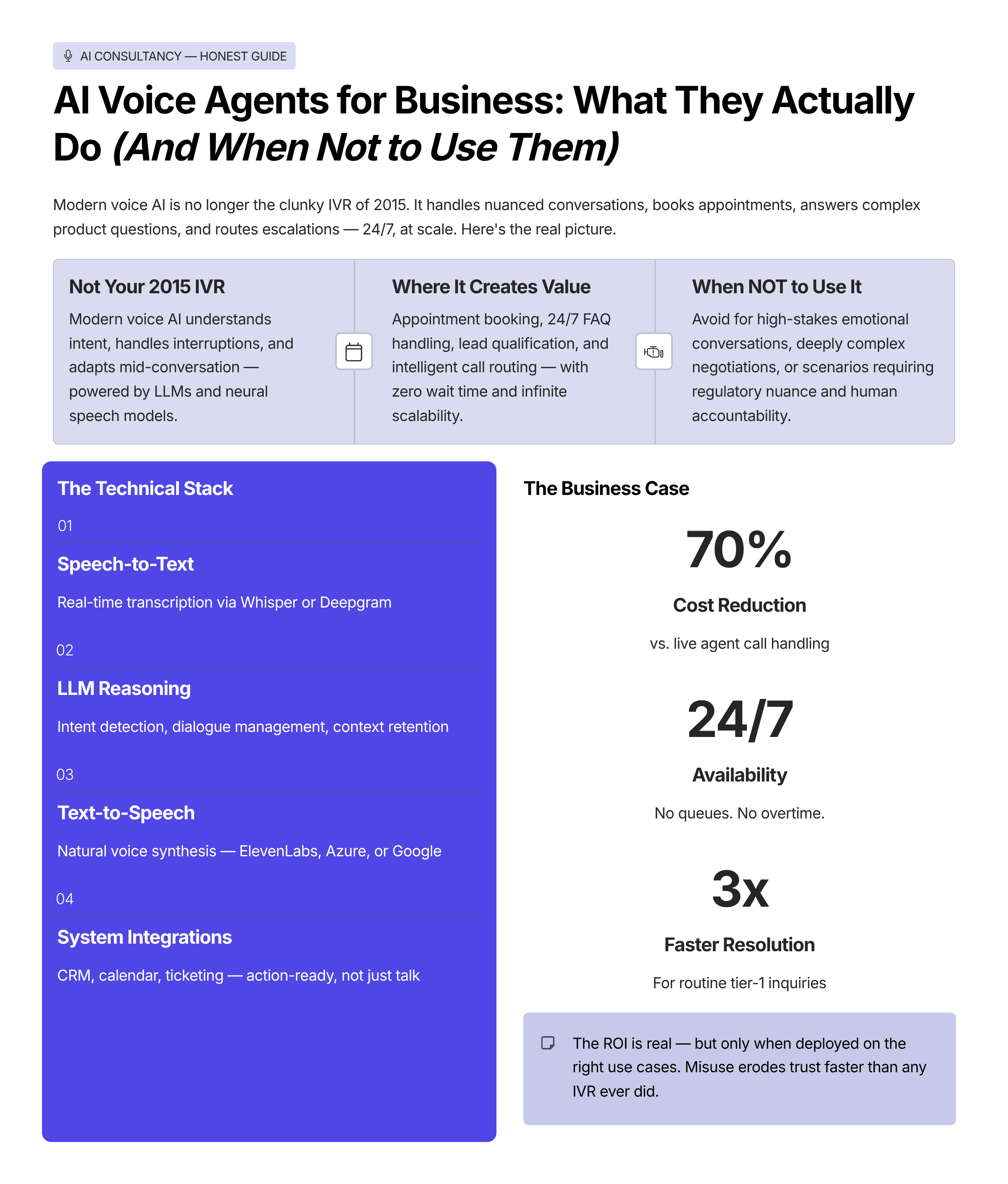
Press 1 for sales, press 2 for support — the IVR systems that trained customers to hang up are not what's being deployed in 2025. Modern AI voice agents use large language models with low-latency speech synthesis to hold contextual, natural conversations. They understand intent, handle interruptions, and recover from unexpected inputs. The gap between current capabilities and "human-sounding" has narrowed to the point where most callers can't tell the difference in well-designed deployments.
Where Voice AI Creates Real Value
Use Case 1: Inbound Appointment Booking
A prospect calls your business number at 11pm. A voice agent answers, asks qualifying questions, checks calendar availability, and books the appointment — all in under 3 minutes. The caller gets an SMS confirmation. Your rep gets a Slack notification for their 9am with full context. This use case alone typically generates 15-25% more booked appointments for service businesses by capturing calls that previously went to voicemail.
Use Case 2: Outbound Follow-Up
After a trade show or webinar, an AI makes outbound calls to a list of attendees to gauge interest and book follow-up meetings. Human reps focus on warm conversations; the AI handles the volume of cold initial contact. Typical connect rate improvement: 3-4× vs. email-only follow-up.
Use Case 3: Customer Support Tier 1
Order status, appointment rescheduling, basic product questions, returns initiation — all tier 1 support that doesn't require human judgment. A well-deployed voice AI can handle 60-75% of inbound support volume, routing only complex or escalated issues to human agents.
When NOT to Use Voice AI
Voice AI is wrong for: complex technical troubleshooting requiring access to proprietary systems, emotionally sensitive conversations (medical, legal, financial advice), situations where the caller is already frustrated and needs to feel heard immediately, and any use case where misunderstanding a request has significant downstream consequences. Know the capability boundary before you deploy.
The Technical Stack
Production voice AI implementations typically combine: a real-time speech-to-text layer (Deepgram for speed and accuracy), an LLM for conversational reasoning (GPT-4o or Claude 3.5 for complex conversations), a text-to-speech layer (ElevenLabs for human-quality voice), and a telephony layer (Twilio or Vonage for call handling and PSTN connectivity). These are orchestrated via a voice AI platform (Retell AI, VAPI, or Bland.ai) or custom-built for large-scale deployments.
The Business Case
The ROI for voice AI in appointment-based businesses is straightforward: if a voice agent books 15 additional appointments per month at your average deal value, that's your payback calculation. Add the cost of the calls that previously went to voicemail and were never recovered — that's your true opportunity cost of not deploying.