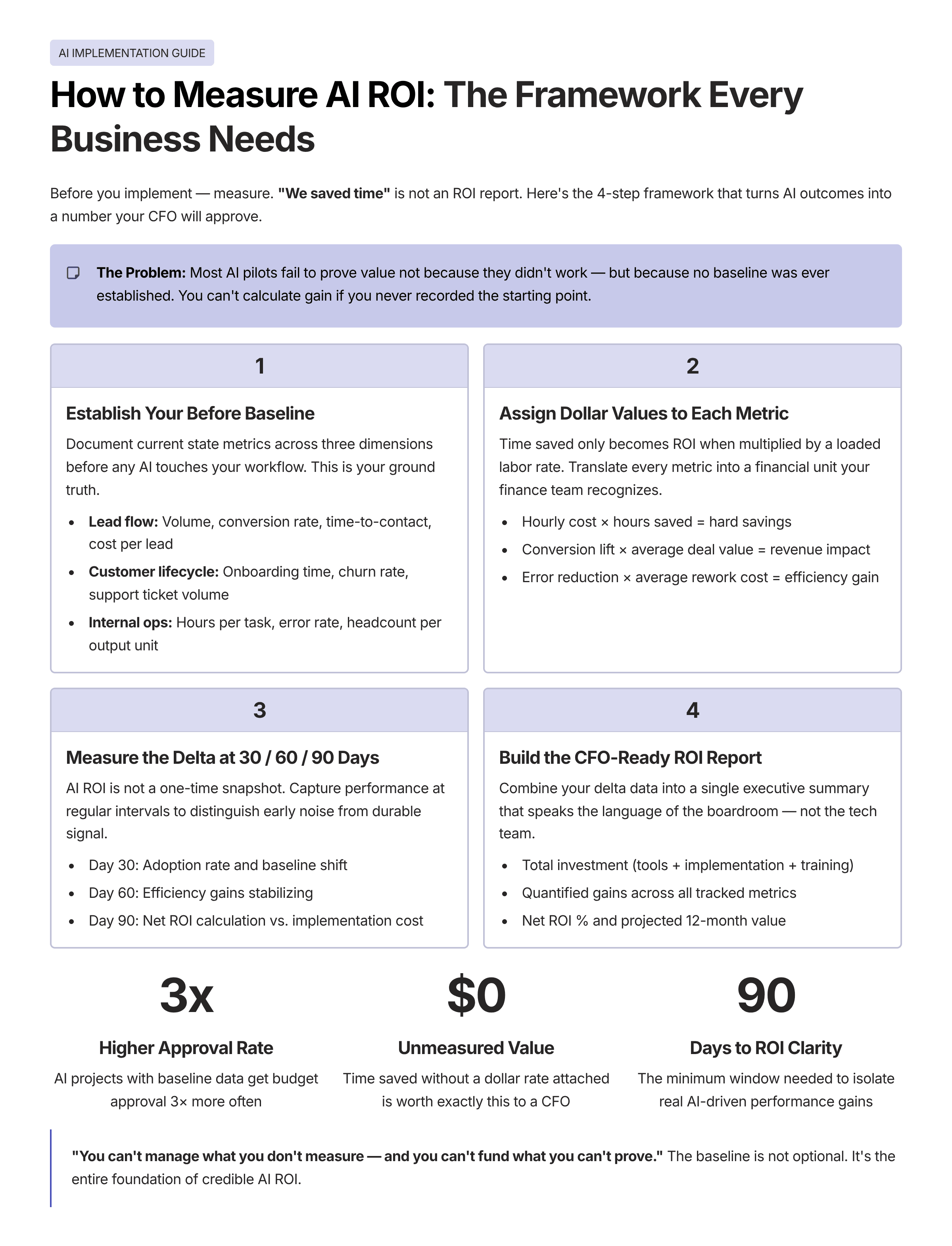
How to Measure AI ROI: The Framework Every Business Needs Before Implementing
Why "Time Saved" Is Not Enough
Every AI vendor promises you'll "save hours." The problem: saved hours don't automatically translate to revenue unless those hours go into revenue-generating activities. A proper AI ROI framework measures three categories of impact: cost reduction, revenue acceleration, and risk reduction.
Step 1: Establish Your Before Baseline
Before any implementation begins, document the current state metrics for the process being automated. This is non-negotiable — without a baseline, you can't prove impact. Key metrics by use case:
- Lead flow: Current lead response time, lead-to-opportunity conversion rate, monthly leads processed
- Customer lifecycle: Average churn rate, NPS, time-to-value, onboarding completion rate
- Internal ops: Hours/week spent on the process, error rate, cycle time
Step 2: Define Success Metrics Before You Build
Agree with stakeholders on what "success" looks like before the system is built. This prevents post-hoc goal-shifting and ensures the system is designed around the right outcomes. For a lead response system, success might be: response time < 2 minutes, lead-to-meeting conversion rate > 15%, implementation cost recovered within 90 days.
Step 3: Track During and After Implementation
Implement measurement instrumentation as part of the system build — not as an afterthought. n8n workflows can log every execution to a Google Sheet or database. Use a rolling 30-day comparison vs. your baseline throughout the implementation.
The ROI Formula That Holds Up to CFO Scrutiny
ROI = ((Revenue Recovered + Cost Saved) - Implementation Cost) / Implementation Cost × 100

Example:
- Revenue recovered (improved conversion): $24,000/month
- Cost saved (admin hours eliminated): $6,000/month
- Implementation cost (one-time): $18,000
- Monthly ROI from month 2 = ($30,000 - $0) / $18,000 = 167%
- Payback period: less than 1 month
Step 4: Communicate Results at the Right Level
Different stakeholders need different framings of the same data. Engineers want uptime and error rates. Ops managers want hours saved and process cycle time. Finance want payback period and ARR impact. Revenue leaders want conversion rate delta and pipeline velocity. Build your reporting layer to serve all four — the same underlying data, presented differently.
The One Thing Most Teams Get Wrong
They measure the AI system in isolation rather than as part of the revenue system it sits within. An AI lead response system that fires perfectly but routes to a rep with no call capacity generates zero ROI. The measurement framework must account for the full system — not just the automation layer.